Just had a thought that I need to capture before it escapes:
Could you run OpenSim as a shared application inside Wonderland? This may seem like an insane idea, I realise. Why would you want a 3D environment inside a 3D environment?
Well, I'm thinking about the draft evaluation of the first pilot by Steve and Marga, and one of the important issues that has been identified is the need to know when to do 'distance', and when to do 'blended'. I think that OpenSim standalone is just right for teaching building skills in a real life blended learning situation (Ian & Graham tutors), and Second Life is best done at a distance (Cubist and Kisa mentors).
Wonderland is closer to a blended learning environment, in that you are your real life self, speaking with your real voice, and you can interact properly with an application (interface elements and all) like you do in an I.T. lab. That's why I think it might be interesting to have OpenSim standalone as a shared virtual application. I can teach some building skills at a distance without it getting muddied by the whole role play and social complexity thing.
Well, it's just an idea.
Wednesday, 27 August 2008

Monday, 25 August 2008
Browser Tutorial
Quick note to Open Habitat project:
The new Browser Tutorial that Linden Lab are introducing as an alternative the to current Orientation island/HUD solution will need to be considered in relation to our first pilot. I sense new opportunities for smoother, better designed noobs inductions. Need to test.
The new Browser Tutorial that Linden Lab are introducing as an alternative the to current Orientation island/HUD solution will need to be considered in relation to our first pilot. I sense new opportunities for smoother, better designed noobs inductions. Need to test.
Wednesday, 20 August 2008
PC News 2012: Thousands sue for repetitive neck strain injury
Now then. A 3D head tracking controlled operating system. That would be interesting. Webcams are pretty widespread, so it would be easy for Apple or the Linux mob to create a head tracking powered 3D desktop. It would seem that many of the benefits of stereoscopic displays can be provided by a realtime head tracking, but at a fraction of the cost and/or inconvenience (nobody really likes wearing those glasses for very long, however spectacular the stereo vision is.).
Now imagine that a friend's 3D head-avatar (see previous posts) pops up on your 3D desktop (well, he'd have to knock first). He can see what's on your desktop, and his 3D head rotates around so you can see which bits he's looking at. You can show him how to do something cool in photoshop, or show him something on the web, accompanied by a VoIP-conversation. Click a switch and you're looking at his screen, and he can see your 3D head-avatar on his 3D desktop.
Now imagine that a friend's 3D head-avatar (see previous posts) pops up on your 3D desktop (well, he'd have to knock first). He can see what's on your desktop, and his 3D head rotates around so you can see which bits he's looking at. You can show him how to do something cool in photoshop, or show him something on the web, accompanied by a VoIP-conversation. Click a switch and you're looking at his screen, and he can see your 3D head-avatar on his 3D desktop.
Head tracking enabled MMORPG
This is the sort of thing I'm on about:
I'll have a search and see if anyone has done it with Second Life yet.
I'll have a search and see if anyone has done it with Second Life yet.
Augmental reality
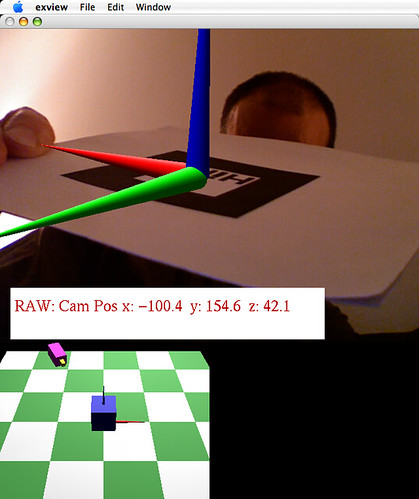
I've been messing about with the open source, cross platform ARToolKit. This uses your webcam to detect the relative position of a special pattern that you print out. I've also just stumbled on this face detection API that does a similar thing, but without the need for a special pattern (other than your face). The second video on this page suggests an interesting creative possibility. The API is a low level C library, so it would probably be fairly easy to integrate it into a hack of the Second Life client. The idea is that you would be able to tilt your head to see round objects slightly. This would be a massive help when building things in world, as you would get a much better sense of the relative position of objects in the 3D space.
Imagining a future augmentationist virtual world
OK. Time for a bit of abductive reasoning. I'm imagining a future shared virtual environment for the augmentationists.
I'm assuming that Second Life has become the best immersionist solution - great for role-play (fantasy identities, not spoilt by voice), content creation etc. So no need to bother trying to compete in these areas. The thing that I'm imagining is a 3D conferencing tool, with voice as the central communication device, and shared applications such as browsers and whiteboards to facilitate discussion, ideas generation and collaborative working.
So, let's pretend I'm a student. My tutor has given me a web-link to a Java Web-start application. The first time I run it, it checks my PC spec and installs all the necessary bits on my computer. My user ID (taken from BANNER or whatever standard is in place for student IDs) is already on the database, so I just need to log in using this and my usual password. As this is the first time I have logged in, I need to first create my avatar. The application checks to see if I have a functioning webcam, and if so, allows me to take a snapshot of myself. If I have no webcam, I have the option of uploading a mug-shot instead. I click a few points on the snapshot to calibrate my face, and click 'Generate'. A 3D face is created and uploaded to the server. Now I log into the virtual world, and my avatar is my 3D face (do we need bodies in virtual worlds? I went to a virtual reality conference about 15 years ago, and one of the speakers was dead against avatars having legs).
As I wander around this 3D world, I see other faces that I recognise. I wander up to them and say 'Hello!', with my voice. They say 'Hello!' back, with their familiar voices. I click on a 'Smiley' button and my 3D face smiles at them. I can see what they are looking at by the orientation of their 3D faces. We walk up to a giant web browser and I key in a URL. My friend admires my new artwork that I have navigated to via the browser. He clicks on an 'impressed' button and his 3D face's expression morphs into an impressed looking version of himself. He has an idea, and draws it on the whiteboard next to the browser. We agree to meet up for a drink later to discuss our new ideas.
Looking a little further into the future, instead of a fixed 3D face, my 3D webcam places a live hologram of me into the virtual environment, massively enhancing communication via non-verbal cues. I interact with the environment by waving my arms about, maybe.
I'm assuming that Second Life has become the best immersionist solution - great for role-play (fantasy identities, not spoilt by voice), content creation etc. So no need to bother trying to compete in these areas. The thing that I'm imagining is a 3D conferencing tool, with voice as the central communication device, and shared applications such as browsers and whiteboards to facilitate discussion, ideas generation and collaborative working.
So, let's pretend I'm a student. My tutor has given me a web-link to a Java Web-start application. The first time I run it, it checks my PC spec and installs all the necessary bits on my computer. My user ID (taken from BANNER or whatever standard is in place for student IDs) is already on the database, so I just need to log in using this and my usual password. As this is the first time I have logged in, I need to first create my avatar. The application checks to see if I have a functioning webcam, and if so, allows me to take a snapshot of myself. If I have no webcam, I have the option of uploading a mug-shot instead. I click a few points on the snapshot to calibrate my face, and click 'Generate'. A 3D face is created and uploaded to the server. Now I log into the virtual world, and my avatar is my 3D face (do we need bodies in virtual worlds? I went to a virtual reality conference about 15 years ago, and one of the speakers was dead against avatars having legs).
As I wander around this 3D world, I see other faces that I recognise. I wander up to them and say 'Hello!', with my voice. They say 'Hello!' back, with their familiar voices. I click on a 'Smiley' button and my 3D face smiles at them. I can see what they are looking at by the orientation of their 3D faces. We walk up to a giant web browser and I key in a URL. My friend admires my new artwork that I have navigated to via the browser. He clicks on an 'impressed' button and his 3D face's expression morphs into an impressed looking version of himself. He has an idea, and draws it on the whiteboard next to the browser. We agree to meet up for a drink later to discuss our new ideas.
Looking a little further into the future, instead of a fixed 3D face, my 3D webcam places a live hologram of me into the virtual environment, massively enhancing communication via non-verbal cues. I interact with the environment by waving my arms about, maybe.
3D faces from mug-shots
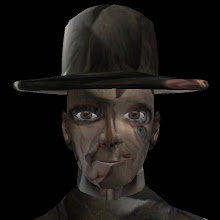
I've found a great tool for generating 3D heads from a single mug-shot. (Click on the 3D face and then move the slider). The one above was created from a standard Photo Booth snap from the built in webcam on my MacBook. The processing is all done via a web interface, probably server side. It's a bit useless at the moment, as all you get is the thing above, but there are plans to allow export of the meshes and textures. I think some of the other augmentationist commercial virtual worlds might already be using something like this (Twinity?). It would make a lot of sense to see something that actually looks like the student you are dealing with in an augmentationist environment, rather than the spooky doll avatars that exist currently. It might be a good intermediate stage until the technology speeds up enough to allow the sort of live 3D video that I mentioned in my last post.
Subscribe to:
Posts (Atom)